 SEOAnything
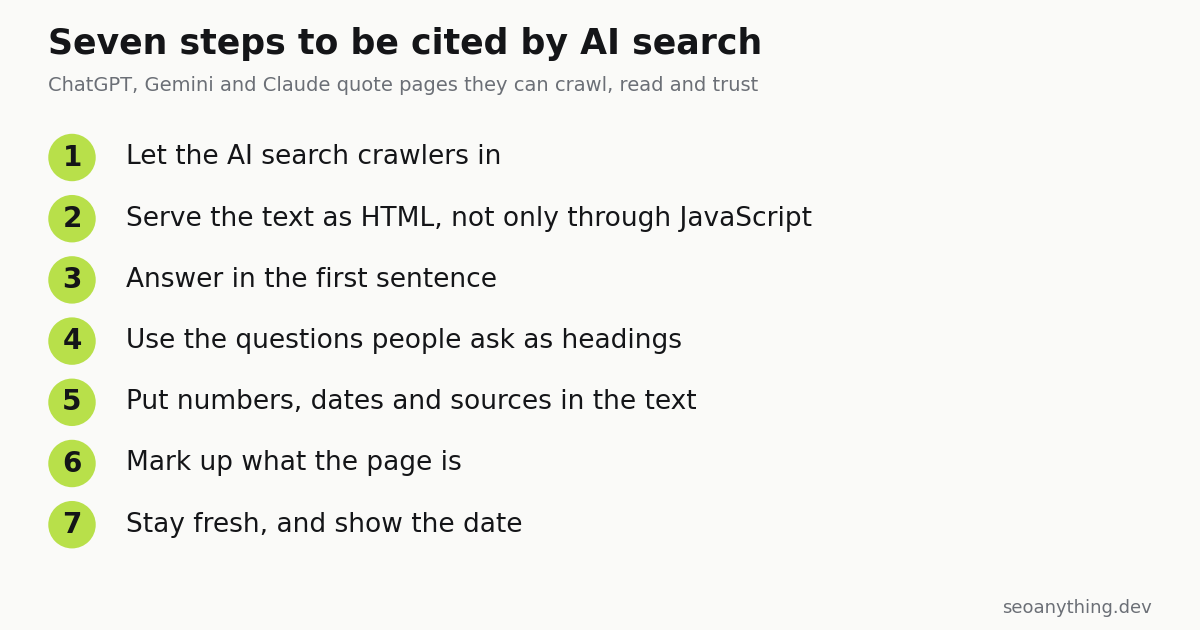
AI assistants such as ChatGPT, Gemini and Claude answer questions about trending topics by searching the web and quoting a few pages. To be one of those pages, a post has to be reachable by their crawlers, clear enough to quote, and fresh. The seven steps below are the ones we apply to every post in this series.
1. Let the AI search crawlers in
An assistant cannot cite a page it is not allowed to read. Each company uses named crawlers, and a site's robots.txt can block them without the owner noticing.
| Assistant | Crawler names to allow |
|---|---|
| ChatGPT search | OAI-SearchBot |
| Claude | Claude-SearchBot |
| Perplexity | PerplexityBot |
| Google AI answers | Googlebot |
| Bing and Copilot | Bingbot |
The companies document these: OpenAI's crawler overview and Google's list of crawlers. Check your own file, or paste a page address into the free page check on the SEOAnything home page, which reports which AI search crawlers your robots.txt lets in.
2. Make the page readable without JavaScript
Many AI crawlers do not run JavaScript. If the text appears only after scripts load, the crawler sees an empty page. Serve the article as HTML. To test, view the page source and search for your first sentence.
3. Answer in the first sentence
Assistants quote short, complete statements. Compare:
- Weak: "In this article we will explore the many questions around the upcoming sale."
- Strong: "Black Friday 2026 falls on Friday 27 November, and Cyber Monday on 30 November."
The second can be lifted into an answer as it stands. Write one such sentence under every heading. Our Black Friday keyword research is built that way.
4. Use headings that are questions people ask
The suggestions in a search box are real questions. "what is gta 6 coming out on" and "can solar eclipse blind you" are typed as they are spoken, and people ask assistants the same way. Use them as headings, in the reader's words, and answer directly below. The keyword tool lists them for any topic and market.
5. Put numbers, dates and sources in the text
Specific facts get cited; general statements do not.
- Give the number and its unit: "more than 20,000 searches in India on 12 November 2026".
- Give the date for anything that changes.
- Name the source and link it. Assistants prefer pages that show where a fact came from.
- Use a table for comparisons. Tables are easy to extract.
6. Mark up what the page is
Structured data tells a machine what it is reading. For articles, use the schema.org types Article or NewsArticle with the headline, author, published date and modified date. Add FAQPage for questions the page shows, and Event or SportsEvent where they apply. Only mark up what is visible on the page.
A plain-text summary of the site helps too. The llms.txt proposal describes a file at the root of a site that lists its main pages for language models. SEOAnything publishes one at /llms.txt.
7. Stay fresh and say so
On a trending topic, the newest accurate page wins.
- Show the published and updated dates on the page and in the markup.
- Update the same URL when facts change. Do not publish a second page.
- List the page in your sitemap with a correct last-modified date.
- Tell search engines when it changes. The IndexNow protocol notifies Bing and other engines at once. Several AI assistants draw on those indexes.
What does not work
- Repeating the keyword. Assistants do not count words.
- Hidden text addressed to AI models. It is treated as spam, and it is dishonest.
- Publishing many near-identical pages. One strong page per question is enough.
- Claims without sources. They are the first to be dropped.
How to check whether it worked
- Ask the assistants. Put the main question to ChatGPT, Gemini and Claude with web search on, and see which pages they cite.
- Check your logs. AI crawlers identify themselves in the user agent. If none has fetched the page, nothing can cite it. The AI crawler log reader in the SEO tools reads a log file in your browser and counts visits per crawler.
- Audit the page. AI visibility checks how AI crawlers and assistants can read, understand and cite a page, and lists what to fix.
Trending topics raise the stakes
When a topic is new, assistants have little to draw on, and the first clear, sourced page often becomes the one they quote. That is an opening for small sites. It is also why accuracy matters more than speed: an assistant that repeats your mistake spreads it to everyone who asks. The same-day method in how to turn a trending search into a post keeps the research steps for that reason.
The short version
Allow the crawlers, serve real HTML, answer first, use the reader's questions as headings, cite numbers with sources, mark up the page, and keep it current. None of this is a trick. It is what makes a page useful to a person, and the assistants were built to find pages like that.
FAQ
How do AI assistants choose which pages to cite?
They search the web and quote pages they can crawl and read, favouring clear, specific statements with sources and recent dates.
Which crawlers should I allow for AI search?
OAI-SearchBot for ChatGPT search, Claude-SearchBot for Claude, PerplexityBot for Perplexity, plus Googlebot and Bingbot, whose indexes also feed AI answers.
Does an llms.txt file help?
It is a proposed standard that lists a site's main pages for language models. It can help models find the right pages, but it does not replace crawlable, well-written content.
Comments 0
Join the conversation. Log in or create an account to like and comment.
Confirm your email to comment. The link is in your inbox.
No comments yet. Start the conversation.