 SEOAnything
Transfer rumours filled Australia's trending list on 12 November 2026: "lewis hamilton mclaren transfer rumors" (200+ searches), "will mclachlan brisbane lions departure", "mikaele ravalawa castleford tigers exit", and in rugby league "cameron munster sydney roosters rumors" and "josh addo-carr parramatta eels future". Rumour is one of the largest content categories in sport, and one of the easiest to get wrong. This post shows what fans search and how to cover a rumour without inventing anything.
The trending searches are from the daily feed in SEOAnything's trend radar, and the suggestions are live autocomplete results pulled with keyword research, both on 12 November 2026.
The shape of a rumour search
Every trending rumour that day followed one template:
player name + club name + a word for movement
| Movement word | Example from 12 November 2026 |
|---|---|
| transfer rumors | lewis hamilton mclaren transfer rumors |
| rumors | cameron munster sydney roosters rumors |
| departure | will mclachlan brisbane lions departure |
| exit | mikaele ravalawa castleford tigers exit |
| future | josh addo-carr parramatta eels future |
The searcher already knows the rumour. They are looking for confirmation: is it true, who said it, and what happens next.
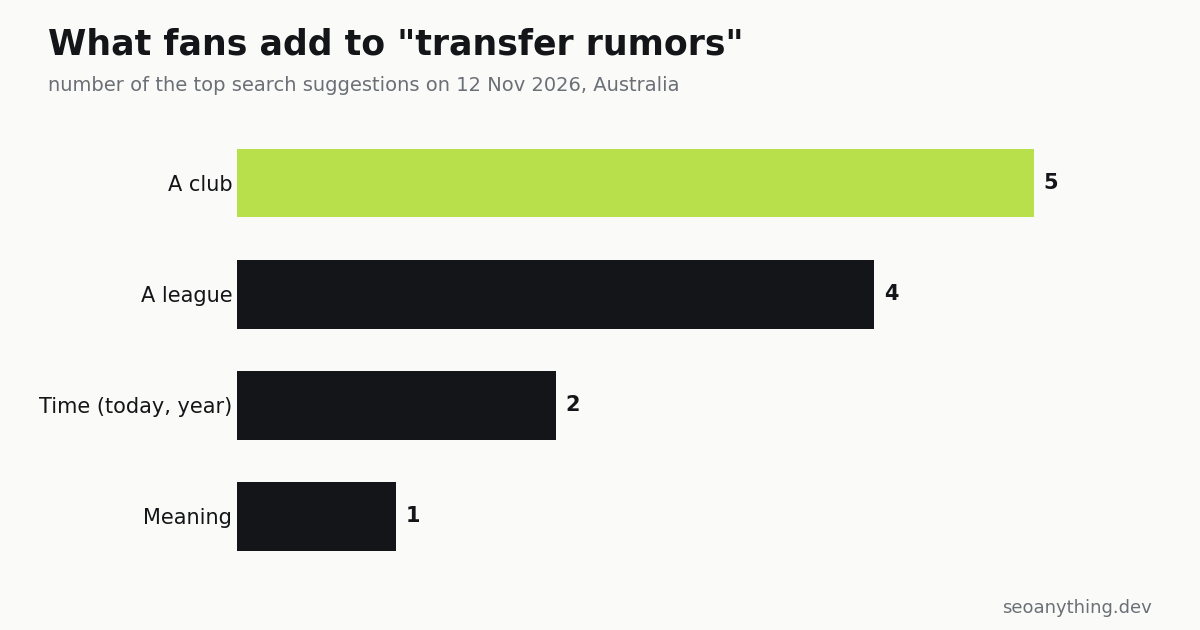
What people type after "transfer rumors"
| Intent | Suggestions (Australia) |
|---|---|
| By league | transfer rumors premier league, premier league transfer rumors, mls transfer rumors, transfer rumors soccer |
| By club | transfer rumors liverpool, transfer rumors real madrid, man city transfer rumors, chelsea transfer rumors, arsenal transfer rumors |
| By time | transfer rumours today, transfer rumors 2025 |
| Meaning | what are transfer rumors |
Club names dominate. Fans follow one team and search it by name, every day of a transfer window. Note the two spellings too: "rumors" and "rumours" both appear, and Australian and British readers use the second.
The honest structure for a rumour page
A rumour page has to keep two things apart: what was reported, and what is confirmed.
- Start with the status in one line. "Reported, not confirmed", "Confirmed by the club", or "Denied by the player".
- Say who reported it, and link to them. "According to" followed by a named outlet. If you cannot find a named source, you do not have a story.
- Say what is confirmed. Contract length, public statements, official announcements. These come from the club, the league or the player.
- Say what would have to happen next. A fee, a medical, a registration deadline.
- Date every update. Rumours change daily.
A reader who finishes that page knows exactly how much to believe. That is the service.
What not to do
- Do not write a rumour as fact in the title. "Hamilton joins" when nothing is signed is false, and the page will be wrong forever.
- Do not invent a source. "Sources say" with no source behind it is fabrication.
- Do not copy another site's exclusive without credit.
- Do not leave a dead rumour standing. When the club denies it, update the first line. An accurate "this did not happen" page keeps earning trust.
Statements about real people carry legal risk as well as ethical weight. Reporting that a named person is leaving an employer, when they are not, can harm them.
One page per saga, not per whisper
A transfer story runs for weeks. Publishing a new article for each small development leaves a trail of thin pages that compete with each other. One page per player and club, with a dated timeline that grows, serves the reader better and collects all the links in one place. When the move is confirmed or dead, the same page states the outcome.
Mark it up correctly
For news pages, the schema.org type NewsArticle with accurate published and modified dates tells search engines when the page last changed. Google's guidance on helpful, reliable content asks the same questions a reader would: who wrote this, how do they know, and is it accurate.
Where the open space is
Big outlets cover the biggest names. The trending list shows how many smaller stories exist: an AFL player, a rugby league winger, a Super League move. Local and specialist sites that follow one club or one competition closely can be the best source for those, because they know who is reliable.
Club news follows the same daily rhythm; see Man Utd news searches. For match-day searches, see how sports score searches work.
Track it yourself
The signed-in trend radar shows rumour searches the day they start in each market, with the news articles behind them, and the topic radar grouped the rugby league rumours into one topic that day.
FAQ
What do fans search during transfer season?
A player's name with a club and a word such as rumours, exit, departure or future, and club-level searches such as Arsenal transfer rumours.
How should a site report a transfer rumour?
State the status first (reported, confirmed or denied), name and link the original source, separate confirmed facts from reports, and date every update.
Is it better to write many short rumour articles or one page?
One page per player and club, with a dated timeline. It serves readers better and gathers links in one place.
Comments 0
Join the conversation. Log in or create an account to like and comment.
Confirm your email to comment. The link is in your inbox.
No comments yet. Start the conversation.