 SEOAnything
"spacex launch" passed 2,000 searches in the United States on 12 November 2026, with "space x launch" and "spacex" adding 1,000 each. Unlike most trending searches, this one returns every few days, each time a rocket is on the pad. That makes it one of the best examples of a repeating search, and a repeating search rewards one maintained page far more than many new ones.
The lists are live autocomplete suggestions from Google, YouTube and DuckDuckGo, pulled with SEOAnything keyword research on 12 November 2026.
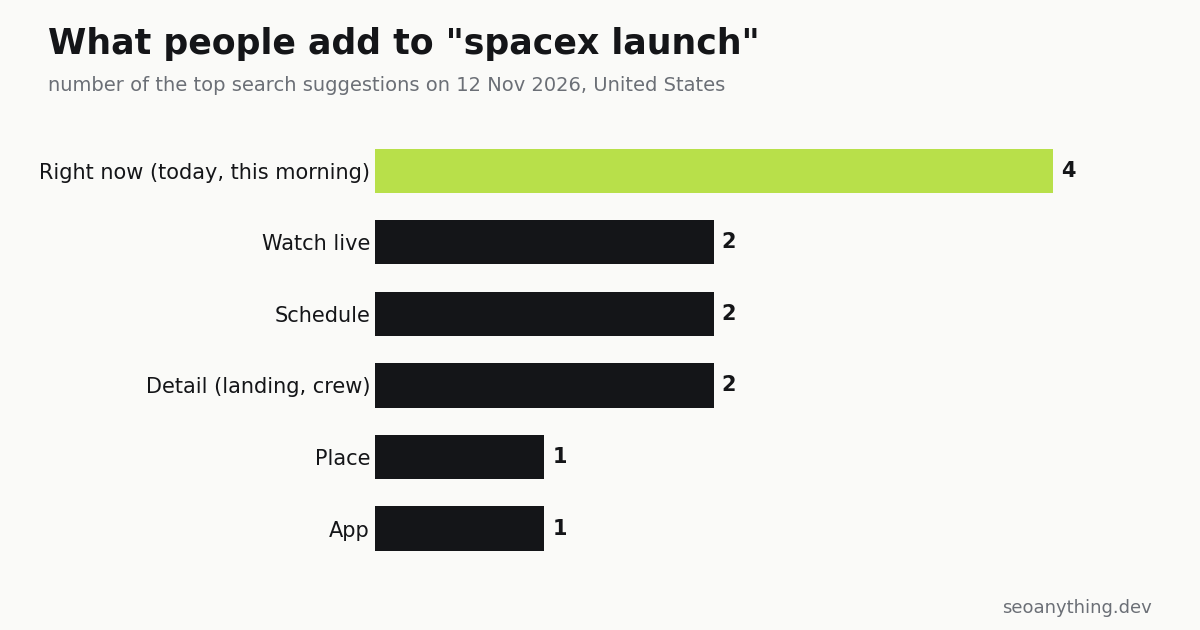
What people type after "spacex launch"
| Intent | Suggestions (United States) |
|---|---|
| Right now | spacex launch today, what is spacex launching today, spacex launch this morning, spacex launch for today |
| Watch | spacex launch live, spacex launch today live |
| Plan | spacex launch schedule, spacex launch schedule 2026 |
| Place | spacex launch vandenberg |
| Detail | spacex launch and landing, spacex launch with crew |
| Tool | best spacex launch app |
Six of the twelve suggestions contain "today", "live" or "this morning". The searcher is asking one question: what is launching, and when can I watch it?
Three spellings, one intent
The trending list held "spacex launch", "space x launch" and "spacex" on the same day. People split the company name in two, and a page that only uses one form misses the other. Write the name correctly in the title, and use the two-word form once in the text.
Why one page beats fifty
A launch happens, the search peaks, and the next launch follows days later. Publishing a new article for each one means every article starts with no links and no history, and last week's page competes with this week's.
The alternative is a single schedule page:
- One permanent URL, such as /spacex-launch-schedule.
- The next launch at the top: mission name, date, launch window in local time and UTC, launch site, and where to watch.
- A table of upcoming launches below it.
- A short log of recent launches with the outcome of each.
- A visible "last updated" line. Launch times slip often, and a stale time sends a reader outside at the wrong hour.
The page gathers links all year, and each launch brings the same searchers back to it.
Get the facts from the source
Launch dates change with weather and technical checks, sometimes hours before lift-off. Take times from the operator's own launch page and say when you checked. Never copy a time from another blog. If a launch is postponed, change the page first and explain second.
For the event itself, the schema.org type Event lets you state the start time and location in a form search engines read. Update it when the time moves.
Serve the local searcher
"spacex launch vandenberg" shows that people near a launch site search by place. They want to know whether they can see it from where they live, and when to look up. A paragraph per launch site, with viewing direction and the time in the local zone, answers a question the national outlets skip.
What not to do
- Do not write "today" into a page you will not update today. A page that says "launching today" three days later teaches readers not to return.
- Do not embed a stream and call it coverage. Add the mission, the payload and the timeline in your own words.
- Do not guess a time. "Not yet announced" is a correct answer.
The pattern applies beyond rockets
Lottery draws, weekly games and daily puzzles behave the same way: the search returns on a schedule. We cover two of them in lotto results searches and wordle hint searches. On 12 November, repeating searches like these sat next to one-off news in every market, as the eight-country comparison shows.
Track it yourself
The trend radar shows the hour a launch search starts to rise, and the keyword tool lists the suggestions in your own market. The public page for the United States shows today's list without an account.
FAQ
What do people search about a SpaceX launch?
Mainly whether there is a launch today, the live stream, the launch schedule and the launch site, for example Vandenberg.
Should I publish a new article for every launch?
No. Keep one schedule page with a permanent URL and update it for each launch. It keeps its links and ranks again each time.
Where should launch times come from?
From the operator's own launch page, with the time you checked. Launch times change often, so a visible last-updated line matters.
Comments 0
Join the conversation. Log in or create an account to like and comment.
Confirm your email to comment. The link is in your inbox.
No comments yet. Start the conversation.