 SEOAnything
Two of Japan's trending searches on 12 November 2026 were four-digit numbers: "2914", with more than 1,000 searches, and "9434", with more than 200. They are stock codes. In Japan every listed company has a numeric code, and investors type the number instead of the name. A third entry combined a company name with 株価, the word for share price. Together they show a search habit that barely exists in English.
The trending searches come from the daily feed in SEOAnything's trend radar, which reads Google's public trending searches for each market. The suggestions are live autocomplete results from Google, YouTube and DuckDuckGo, pulled with keyword research. Both were read on 12 November 2026, and a figure such as 1,000+ is the volume bucket Google reports for that day.
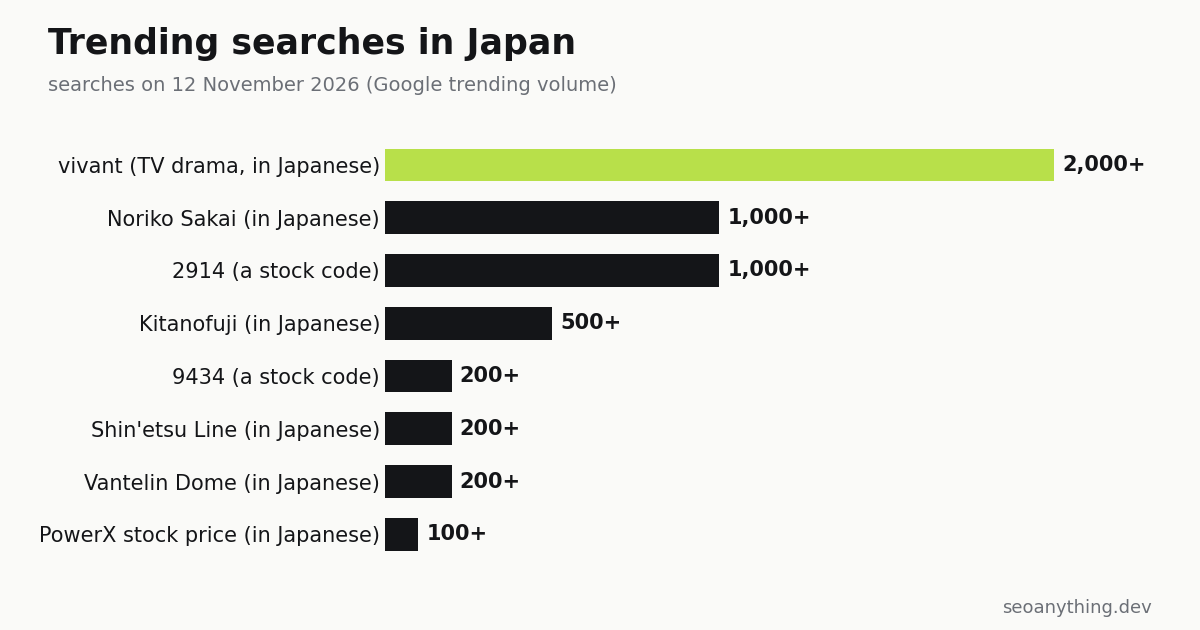
What Japan searched that day
| Search | What it is | Volume |
|---|---|---|
| vivant 薫 | a TV drama and a character name | 2,000+ |
| 酒井 法子 | a person | 1,000+ |
| 2914 | a stock code | 1,000+ |
| 北の富士 | a person | 500+ |
| 9434 | a stock code | 200+ |
| 信越線 | a railway line | 200+ |
| バンテリンドーム | a stadium | 200+ |
| 福井新聞 | a regional newspaper | 200+ |
| パワーエックス 株価 | a company name plus "share price" | 100+ |
| 佐々木舞音 | a person | 100+ |
Every entry is in Japanese script or digits. None is in English.
Why people search a number
Shares on the Tokyo Stock Exchange are identified by a securities code, traditionally four digits. Brokerage apps, newspapers and television all show it beside the company name. The code is shorter to type than a name in Japanese, has no spelling variants, and never matches the wrong company. So investors search it directly.
On Japan Exchange Group's site, 2914 is the code of Japan Tobacco and 9434 is the code of SoftBank Corp. The trending list shows that the codes were searched on 12 November; it does not say what happened to either share, and we do not guess.
What people type after 株価 (share price)
| Intent | Suggestions (Japan) |
|---|---|
| Live | 株価 リアルタイム (real time), 株価 ライブ (live), 株価 最新情報 (latest), 株価 最新情報 ライブ |
| A company | 株価 安川電機, 株価 キオクシア, 株価 富士通, 株価 jt, 株価 nec, 株価 信越化学 |
| A fall | 株価暴落 (share price crash) |
| Lookup | 株価検索 (share price search) |
Six of the twelve suggestions pair the word with a company. People type either the code alone or the word plus a name.
What this means for a publisher
1. The number is a navigational search. Someone who types "2914" wants a quote page. Financial portals and brokers own that result, and a blog has no place in it.
2. Put the code in your page anyway. An article about a company should show its code beside the name in the title or first line, as Japanese media do. It tells readers and search engines exactly which company the page is about.
3. Write for the question after the number. Why did the share move, what do the results say, when is the dividend paid. Those need a writer, and they are where independent pages rank.
4. "Crash" is a search. 株価暴落 appears in the suggestions. Fear is searched as readily as prices. A calm explanation of what a fall means, and what it does not, is worth more than a dramatic headline.
5. Follow the rules for money content. Explain, do not recommend. Name the author and their experience. Cite the exchange, company filings and the regulator, Japan's Financial Services Agency. Date every figure to the minute.
The same habit elsewhere
India's trending list the same day held short letter codes such as "cams" and "fcs" beside "taiwan index" and "usd"; see Taiwan index searches in India. Indonesia searched the dollar rate; see what Indonesia searched. In every market the pattern is the same: the live number goes to data providers, and the explanation is open. The method is in writing for price searches.
The rest of the list
The other entries are entertainment and local life: a television drama, public figures, a railway line, a stadium and a regional newspaper. A railway line usually trends when service is disrupted, and a regional newspaper when readers look for local news; the list itself gives no reason. For a publisher, the point is language: all of it is typed in Japanese.
Writing for Japan
- Write in Japanese, with a native editor. No search in the list was in English.
- Match the script people use. Company names may be typed in kanji, katakana or Latin letters. "jt" and "nec" appear in Latin letters in the suggestions.
- Include codes and official names together.
- Use Japanese sources: the exchange, company disclosures, national and regional press.
Track it yourself
The signed-in trend radar shows trending searches for a market with the headlines behind them. The keyword tool returns suggestions in the language and country you choose, which is how the Japanese list above was made.
FAQ
Why do people in Japan search four-digit numbers?
They are securities codes. Every company listed in Tokyo has one, shown beside its name in apps and newspapers, and investors type the code because it is short and unambiguous.
Which stock codes trended in Japan on 12 November 2026?
2914, the code of Japan Tobacco, passed 1,000 searches, and 9434, the code of SoftBank Corp, passed 200, according to Google's trending searches.
Can a blog rank for a stock code?
Not for the code alone, which leads to quote pages. Blogs can rank for explanations of results, dividends and price moves, and should show the code beside the company name.
Comments 0
Join the conversation. Log in or create an account to like and comment.
Confirm your email to comment. The link is in your inbox.
No comments yet. Start the conversation.