 SEOAnything
On 12 November 2026, we looked at the 25 fastest-rising repositories in our trending feed. Twenty-two of them shared the same odd profile: they were named after commercial software, described in the same boilerplate sentence, and held almost the same number of stars. A star count is supposed to signal that developers found something useful. This list shows what happens when stars are treated as a target.
The feed is the open-source view in SEOAnything's trend explorer, which reads public repository data and ranks by star growth.
What the list looked like
| Trait | What we saw in the 22 look-alike repositories |
|---|---|
| Names | Well-known paid products: PDF editors, audio and video suites, DJ software, system utilities, phone unlockers |
| Descriptions | Variations of one sentence: "pre-configured environment", "automated deployment pipeline", "isolated workstation" |
| Language | HTML, or none detected |
| Stars | Two tight clusters: 801 to 828, and 1,044 to 1,053 |
| Other names | Crypto "generators", "drainer" bots, auto-withdraw bots, a Discord "raider" |
Real projects do not behave like this. Popular repositories differ widely in star count, are written in a programming language, and describe what the code does.
What this pattern usually means
Repositories with these traits are widely reported by security researchers to be bait. The page promises a free copy of paid software or a money-making bot, and the download contains malware that steals passwords, browser sessions or crypto wallets. Stars are added in bulk by automated accounts so that the repository looks trusted and climbs trending lists.
We have not downloaded or analysed these files, and we do not name the accounts. The profile alone is enough reason to stay away.
Seven checks before you trust a repository
- Does the name promise paid software for free? That is not open source. It is piracy at best and a trap at worst.
- Does the description say what the code does? Marketing filler with no technical content is a warning.
- Is there source code? A repository with only a readme and a link to a zip file or an external download is not a project.
- How old is the account, and what else has it published? A new account with one repository and a thousand stars did not earn them.
- Do the stars arrive smoothly or in a block? Hundreds of stars in an hour, then nothing, is bought attention.
- Are there issues, pull requests and commits from different people over time? Real use leaves a trail.
- Who starred it? Open a few profiles. Empty accounts created the same week are not developers.
What to do when you find one
- Do not download or run anything from it.
- Report it. GitHub's guide to reporting abuse or spam explains how.
- Warn your team. A developer who installs a "free" tool on a work laptop can expose company credentials.
The three that looked real
The remaining three repositories had the marks of ordinary projects: a programming language (Swift and C++), specific technical descriptions, and star counts that differed from each other, from about 1,600 to about 8,000. Two were tools for studying iOS system configuration, and one described a native recompilation of a classic game. We have not reviewed their code either. They show the contrast: a real project tells you what it is.
Why this matters beyond GitHub
Any ranking built on one number invites people to inflate that number. Stars, downloads, followers, reviews and backlinks have all been gamed. The defence is the same everywhere: look for evidence of real use, from different people, over time.
Search engines learned this with links years ago, which is why a few links from trusted sites outweigh thousands from nowhere. The same judgment applies when you choose a dependency, cite a tool in an article or recommend software to readers. If you write about open source, verify before you link. Sending readers to a malicious repository harms them and your name.
What we are doing with it
Our own trending view ranks by star growth, so it surfaced these repositories too. We would rather show that plainly than hide it.
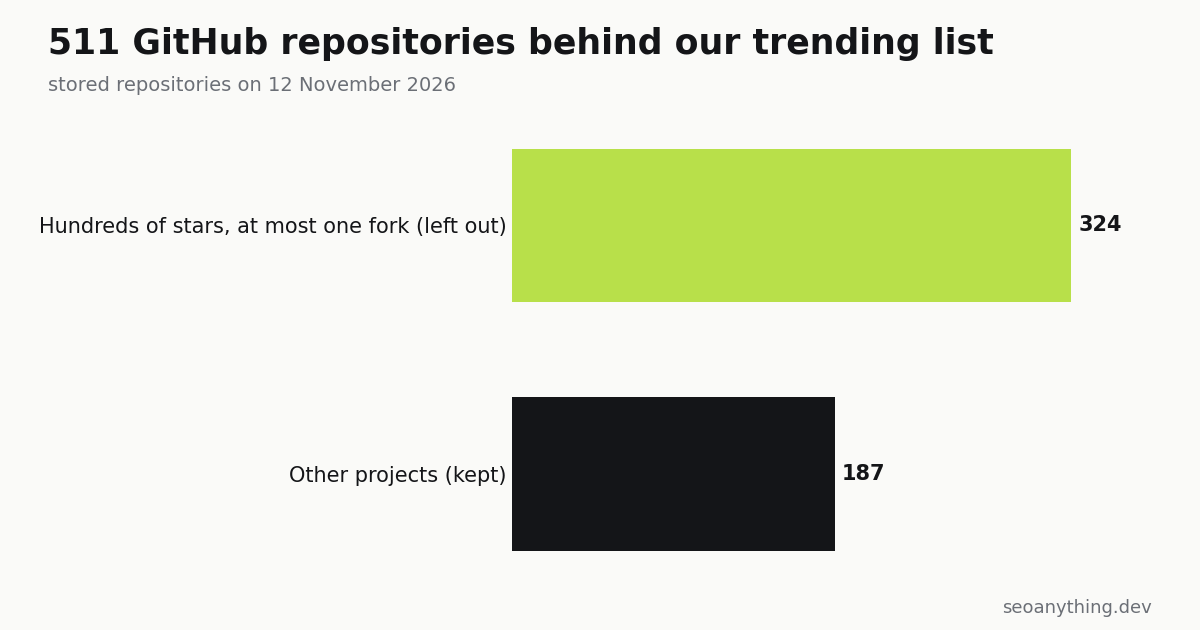
When we looked at the whole pool behind the list, the problem was larger than the top 25: 324 of the 511 GitHub repositories we had stored fit the profile. One number separated them cleanly. The look-alikes had hundreds of stars and almost no forks (98% had none), while the other projects averaged about one fork for every ten stars. People who use a project fork it; bought stars do not.
Since 12 November 2026 our trending lists leave out any repository with 200 or more stars and at most one fork. That removed all 324, and none of the remaining 187 had the bait wording. It is one signal, and a farm that also buys forks would pass it, so treat any star-ranked list, ours included, as a list of candidates to check.
Use trending lists the right way
A trending list is good for discovering names you have not heard. It is not a recommendation. For each interesting entry, run the seven checks, read the code, and look for independent mentions.
The signed-in repositories view shows star history for each project, which makes a sudden block of stars easy to see, and the topic radar groups rising projects with the searches around them. For how search trends behaved the same day, see what eight countries searched on 12 November.
FAQ
Are GitHub stars a reliable sign of quality?
Not on their own. Stars can be added in bulk by automated accounts. Look for source code, commits and issues from different people over time.
How can I spot a fake or malicious repository?
Warning signs include a name that promises paid software for free, a vague marketing description, no real source code, a new account and stars that arrived in one block.
What should I do if I find a suspicious repository?
Do not download or run anything from it, and report it to GitHub through its abuse and spam reporting form.
Comments 0
Join the conversation. Log in or create an account to like and comment.
Confirm your email to comment. The link is in your inbox.
No comments yet. Start the conversation.