 SEOAnything
"earthquake near me" passed 500 searches in Nepal on 12 November 2026. It is one of the most urgent searches there is: people type it within a minute of feeling the ground move, and they want one answer, fast. This post shows what they type next and how a news site, a local authority or a blogger should answer.
The lists are live autocomplete suggestions from Google, YouTube and DuckDuckGo, pulled with SEOAnything keyword research on 12 November 2026.
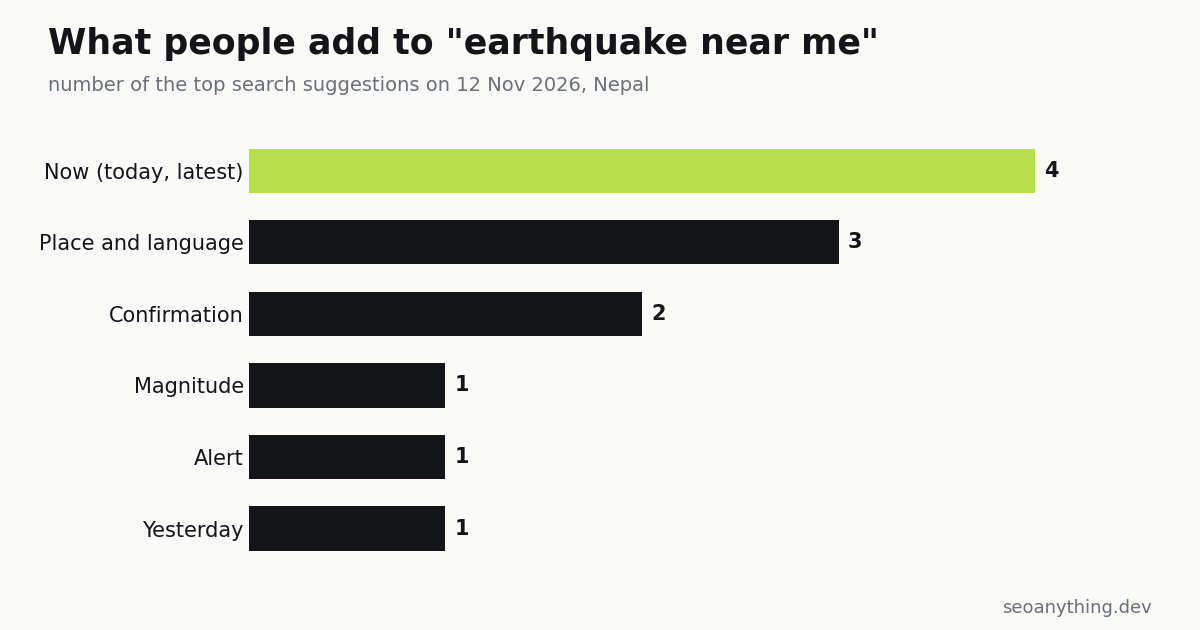
What people type after "earthquake near me"
| Intent | Suggestions (Nepal) |
|---|---|
| Now | earthquake near me today, earthquake now near me, earthquake today near me, latest earthquake near me |
| Confirmation | any earthquakes near me, local earthquake near me |
| Size | earthquake near me magnitude |
| Alert | earthquake near me alert |
| Earlier | earthquake yesterday near me |
| Place and language | earthquake near me in india, earthquake near me in bangladesh, earthquake near me in hindi |
Four of the top suggestions are the same question in different word order: did an earthquake just happen here? The rest ask how strong it was and whether a warning exists.
What the searcher needs, in order
- Was it an earthquake? Yes or no.
- How strong, and where was the centre? Magnitude, depth, distance from the nearest town.
- When? The local time, to match what they felt.
- Is it safe now? Whether aftershocks are expected and what to do.
A page that opens with these four lines has done its job before the reader scrolls.
How to answer
Lead with the facts in one sentence. For example: "A magnitude 4.8 earthquake struck 12 km east of the town at 6:42 PM local time, according to the national seismological centre." No introduction, no history of the fault line first.
Name the source and link it. In Nepal the official source is the National Earthquake Monitoring and Research Center. Worldwide, the USGS latest earthquakes map lists events within minutes. Readers check, and so do search engines.
State the time you last updated. Early magnitudes are revised. Say "preliminary" when it is.
Give safety steps from an authority. Drop, cover and hold on during shaking; expect aftershocks; check gas and structure before going back inside. Link to the official guidance instead of rewriting it from memory.
Write in the language people search in. "earthquake near me in hindi" is in the list. In Nepal, a Nepali version of the page serves most of the people who felt it.
What not to publish
- No guessed magnitude. A wrong number spreads faster than the correction.
- No predictions. Earthquakes cannot be predicted to a day or a place. Pages that claim otherwise cause panic.
- No old photos. Images from earlier disasters, shared as new, are the most common form of misinformation after a tremor.
- No padding above the facts. Someone standing in a doorway does not need three paragraphs before the magnitude.
Why "near me" changes the page
"Near me" means the search engine uses the searcher's location, so the result should be local. A national article about "an earthquake in the region" serves this search poorly. A page for a district or city, updated for each event, serves it well. Local newsrooms and municipal sites have an advantage here that no international outlet can match.
The same day, Nepal's trending list also held three weather searches. Urgent local questions dominate that market, as we show in weather searches in Kathmandu.
Prepare before the next one
The search arrives without warning, so the page must exist first:
- Keep a permanent page titled for the place, for example "Earthquakes near Kathmandu: latest".
- Prepare the layout: facts line, source link, safety steps, update time.
- When an event happens, fill in the first sentence and publish within minutes.
Track it yourself
The trend radar shows the moment this search starts rising in your market, and the public page for Nepal shows today's list without an account.
FAQ
Why do people search "earthquake near me"?
To confirm that the shaking they felt was an earthquake, and to learn its magnitude, location and time within the first minutes.
Where can I check the latest earthquake?
Use your national seismological centre, such as Nepal's National Earthquake Monitoring and Research Center, or the USGS latest earthquakes map.
Can earthquakes be predicted?
No. Scientists can estimate long-term risk for a region, but not the day or place of a specific earthquake.
Comments 0
Join the conversation. Log in or create an account to like and comment.
Confirm your email to comment. The link is in your inbox.
No comments yet. Start the conversation.