 SEOAnything
"car insurance" was a trending search in the United Kingdom on 12 November 2026. It is among the most contested keywords in search, held by comparison sites and insurers with large budgets. The suggestions behind it still show where a smaller site can compete: in the questions, not in the head term.
The lists are live autocomplete suggestions from Google, YouTube and DuckDuckGo, pulled with SEOAnything keyword research on 12 November 2026.
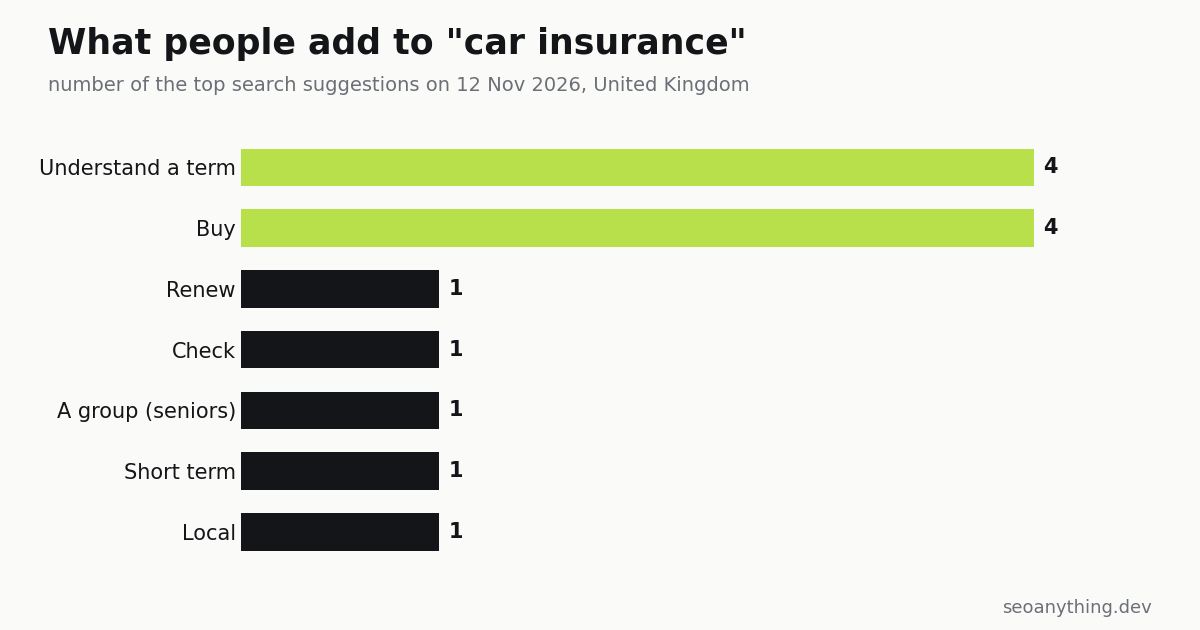
What people type after "car insurance"
| Intent | Suggestions (United Kingdom) | Who ranks |
|---|---|---|
| Buy | car insurance quotes, car insurance online, car insurance comparison, car insurance companies | Comparison sites and insurers |
| Renew | car insurance renewal | Insurers, comparison sites |
| Check | car insurance check | Official databases |
| A group | car insurance for seniors | Mixed |
| Short term | car insurance for a day | Specialist insurers |
| Local | car insurance near me | Brokers with a local listing |
| Understand | what is car insurance excess, what is car insurance premium, what is car insurance policy, what is car insurance fraud | Open |
Three kinds of intent
Transactional. "quotes", "comparison", "online". The searcher is ready to buy. Results are dominated by companies that are authorised to sell insurance and spend heavily to be there. A blog has no business chasing these.
Navigational and official. "car insurance check" is usually someone confirming that a vehicle is insured. In the UK the official service is askMID, run by the Motor Insurers' Bureau. The right page for that search is the official one.
Informational. Four of the top suggestions begin with "what is". Excess, premium, policy, fraud. These come from people who have a renewal letter in hand and do not understand a word in it. This is the open part.
How to win the informational searches
- One page per term. "What is car insurance excess?" deserves its own page with its own title.
- Answer in the first sentence. For example: the excess is the amount you pay towards a claim before the insurer pays the rest. Then explain compulsory and voluntary excess with one worked example in pounds.
- Use the reader's situation. "Your renewal quote went up. Here is how to read it" serves more people than a glossary.
- Keep it current. Rules and typical prices change. Date the page and review it each year.
- Link to the regulator and to free guidance. In the UK that is the Financial Conduct Authority and the government-backed MoneyHelper.
Why trust decides the ranking
Insurance is a money topic, and search engines apply a stricter standard to it. A page is more likely to rank when:
- The author is named and has relevant experience.
- Claims are sourced from the regulator, the statute or the insurer's own policy wording.
- The site says how it earns money. If links pay a commission, say so.
- Nothing is presented as personal advice. Explaining a term is information. Telling someone which policy to buy is regulated advice.
Google sets out this standard in its guidance on helpful, reliable content.
The specific beats the general
Two suggestions point to narrow markets: "car insurance for seniors" and "car insurance for a day". Narrow searches have fewer competitors and clearer answers. A site that knows one group well, such as new drivers, older drivers, classic car owners or people who borrow a car for a weekend, can become the reference for it.
"car insurance near me" is a local search. It shows a map with brokers, taken from business listings. A local broker wins it with a complete, accurate listing and real reviews, not with a blog post.
A realistic plan for a small site
- Skip the head term and the buying terms.
- List every "what is" and "how does" question in your market.
- Write one clear page for each, starting with the answer.
- Group them under a hub page that links to all of them.
- Review the set once a year.
Twenty accurate explainer pages bring steadier traffic than one attempt at "car insurance quotes".
Evergreen searches in a trending list
Most of a day's trending searches are events. This one is not: nothing happened in car insurance on 12 November. It surfaced because enough people searched it that day, as happens when renewals cluster. The UK list held other everyday searches too, such as "lotto results" and "tui". We cover the first in lotto results searches, and the whole day in what eight countries searched.
Track it yourself
The public page for the United Kingdom shows today's list without an account. The keyword tool returns the question-style suggestions for any term in your market, and search visibility checks whether your own pages can be crawled and indexed.
FAQ
Can a small site rank for "car insurance"?
Not realistically for the head term or for quote searches, which comparison sites and insurers dominate. Question searches such as what is car insurance excess are open.
What is a car insurance excess?
The amount you pay towards a claim before the insurer pays the rest. It usually has a compulsory part set by the insurer and a voluntary part you choose.
Why is insurance content held to a higher standard in search?
Because wrong information about money can harm people. Pages do better when the author is named, claims are sourced and the site is open about how it earns.
Comments 0
Join the conversation. Log in or create an account to like and comment.
Confirm your email to comment. The link is in your inbox.
No comments yet. Start the conversation.